
The Blind Swine mate and Corner mate
2 new puzzle themes and tips on sustainable training with puzzles
Overview
As I learn more about chess, and am navigating the Practice page, with all its tactics, I feel that I am making progress in my journey towards understanding the coordination of different pieces and calculation. In this blog post we are going to look at 2 new puzzle themes:
| Practice Section | Puzzle Theme |
|---|---|
| Blind Swine mate | Blind Swine mate puzzle theme |
| Corner mate | Corner mate puzzle theme |
and try to outline a more involved way of solving puzzles, -than just playing one move after the other.
Blind Swine mate
The Blind Swine mate is performed by 2 connected rooks on the 7th rank. The mating rooks are positioned next to each other, thus defending each other, and also trapping the king on the bank rank in an area of 2x2 squares. This is often possible, because the King is castled short, trapped by the 2 rooks and the F8 Rook. The name Blind Swine Mate is a term coined by Polish chess player David Janowski (1868-1927). The pattern gained prominence through the writings and games of Aron Nimzowitsch (1886 - 1935), who emphasized the strategic importance of the seventh rank in his classic book 'My System'. Nimzowitsch demonstrated how control of the seventh rank could lead to devastating tactical outcomes, including this mate and the earlier described Vukovic mating pattern.
This pattern is important in our puzzle collection, because it reflects another classical pattern using moves drawn from our online games. And using these puzzles to learn the pattern, should thus, be very practical and educational. But to make this theme more interesting than just trapping the King on the 7th rank, I have designed this following a rather free interpretation, requiring to trap the King using 2 rooks, not just on the seventh rank, but anywhere on the board.
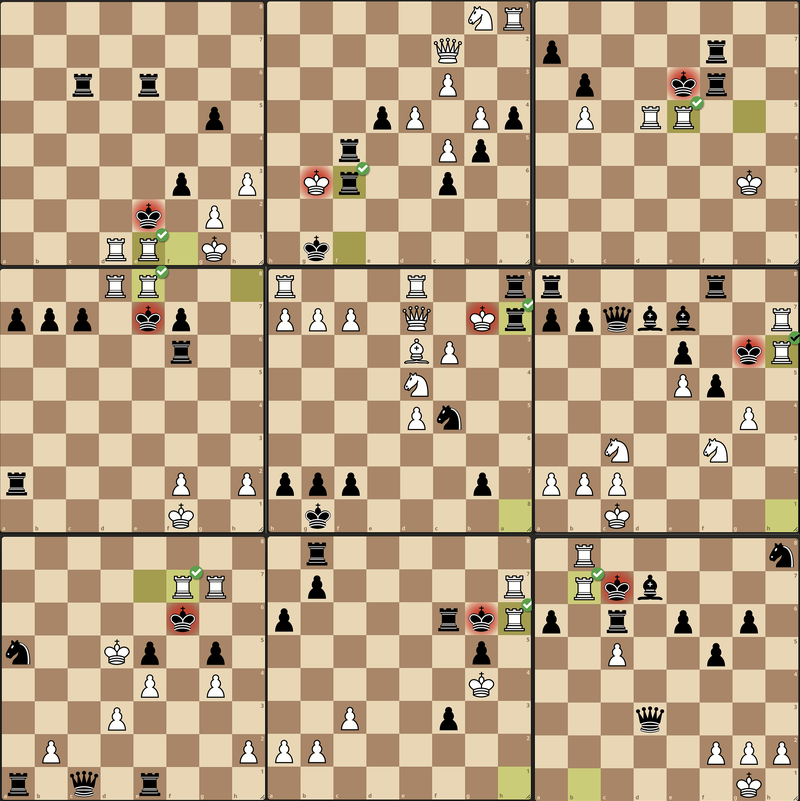
This design should be even more educational, as we learn to use connected rooks and, thus, begin to understand the power of a Battery in chess.
Corner mate
The Corner mate is a great example for coordinating 2 very different chess pieces, the Knight and the Rook or Queen, towards one common goal, -mating the opponent's King. The task of the Queen or Rook in this pattern is to cut-off escape squares of the King, which enables the Knight to hop in for the final blow - check mate. There is no historic background or single source that can be attributed to this pattern. But it's a standard pattern present in many collections of chess patterns these days.
Most references explain the Corner mate pattern by literally trapping the King on the corner of the board: But again, the reality, that I have seen in the lichess puzzle DB data is more complicated. The King can, in practice, also be trapped by a Rook or Queen and checkmated by the Knight in many other positions. Therefore, this theme is also interpreted in a less literal fashion to make playing this type of puzzles more challenging and rather concentrates on coordinating Queen or Rook with a Knight, instead of just moving pieces towards the corner of the board.
Calculations in Chess
I started out using puzzles, thinking, that I could literally memorize each chess position and, would then be fine to solve more advanced patterns, and thus, win more chess games. But I learned recently that this idea is not correct as it captures only a small part of solving chess problems and avoids more complicated situations in chess. I would like to use this section to briefly describing an option for making puzzles even more interesting than just playing them move by move.
Check Capture Threat (CCT/CCA)
A much more interesting and sustainable way for training with puzzles is to actually calculate and foresee the game for the next couple of moves. The method that I have seen here most often is called Check, Captures, Threats (CCT) or also known as Check, Captures, Attack (CCA) as Levy Rozman (GothamChess) describes it in the last chapter of his book "How to Win at Chess".
The overall idea is, that checks should be evaluated first since these can lead to a decisive advantage, while capturing an opponents piece is also adventitious, but not as winning as a potential checkmate. So, captures should be evaluated and executed when the evaluation of a check is not available. And the last letter of CCA/CCT (Attack/Threat) should be handled in a similar fashion. If there are no valuable checks or captures, we should think about attacking or making threats towards the opponents King. This method can be used to evaluate our own options and the options of our opponent. And the interesting thing is that we can practice it using puzzles and apply this later on in the game.
A Practical Example
Take for instance this random mate in 3 puzzle Xqk13 from the available lichess themes Using CCA/CCT we can determine that we have 3 checks:
- Qg1+
- Rg1+
- Rh2
- Qh3+
The first option can be quickly discarded, because we will lose the Queen due to the Bishop or Rook capturing the Queen (Bxg1 or Rxg1). The second option is also not too promising, because g1 is defended by 2 pieces the Rook on f1 and the Bishop on d4.
The third option Rh2+ is a forcing move in the sense that the white King is forced to capture the Rook on h2 (Kxh2) since there is no other way to resolve this position.
So, if we now assume that the Rook in the third variation via Rh2+, Kxh2 is gone, and the white King is on h2, what could be the next useful move? Right, we have 8 squares from which the Queen can check the King and there is also one square Rg2+ from where the g-Rook can check the King. Analyzing these options again leads to the idea that Qg3+ is a good option, because g3 is weak (not defended by the white) and the Queen is defended by the g-Rook.
The King is, in this case, forced to move again to the only escape square h1. But the Queen can follow with the final checkmate on g2 (Qg2#).
All of this is supposed to be visualized in a player's head, and only when this visualization is clear and present, we are supposed to resolve the puzzle to see, if this vision was correct. Lichess provides drawing tools to support our vision (right mouse click and drag), but obviously, playing over the board (OTB), will require us to do all the work in our mind. So, here is a simple visualization of what a calculation can look like, for each move, before solving the puzzle: Obviously, the above example is a simplified version of the real thing, because we had to evaluate mostly checks, since on a lower puzzle ELO, these are the most frequently occurring problems. In reality, we would also have to evaluate other variations, or get to the point where Captures and Threats need to be evaluated. That's why I suggest mating in 1, 2, 3 only to get started and use other puzzles to extent later, when you see all relevant checks without a problem...
The simple example shown looks like a mess, but if you try this, and stick with it for a while, you will notice that you can control the game in a deeper level than before, because you can see things coming, before they are actually happening. And with practice, you will get better. I recommend watching YouTubers or Twitch Streamers like The Chess Centurion or here on lichess: RESET-101 or SorenChessCoach, if you want to know more about this thinking process.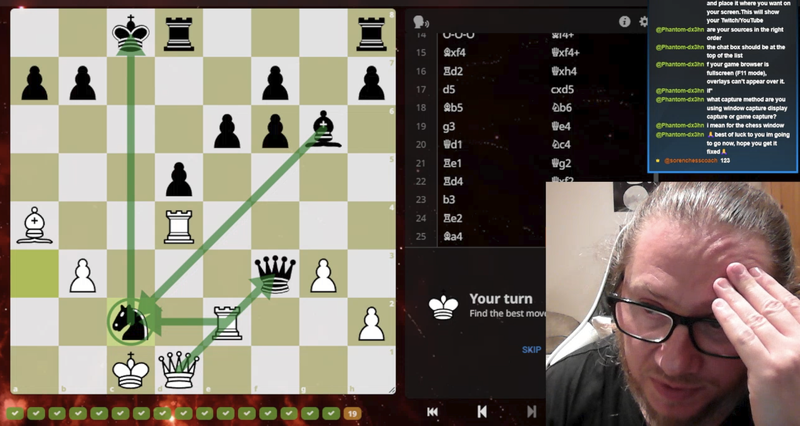
I can already tell that I improved my vision in a sustainable way, because I can get easily (like any time of the day) into the twenties, when playing Puzzle Streak, and once a month into the thirties. Of course I am on a journey and am not willing to stop here. Let me know in the comment section of this blog or my inbox at Lichess, if you can recommend other streamers or resources for learning and improving chess calculations.
You may also like
 dirkster99
The Vukovic Mating Pattern
Another puzzle theme generated from lichess.org data dirkster99
The Balestra Mating Pattern
Another puzzle derived from lichess.org data ChessMonitor_Stats
Where do Grandmasters play Chess? - Lichess vs. Chess.com
This is the first large-scale analysis of Grandmaster activity across Chess.com and Lichess from 200… Kevin_M06
Deep Analysis of Lichess Puzzles
Ahh... Lichess puzzles. Don't we love them? thibault
How I started building Lichess
I get this question sometimes. How did you decide to make a chess server? The truth is, I didn't. Tobs40